The California Federation of Teachers will vote this weekend on a resolution to avoid investing in and to divest from companies advocating for and profiting from the privatization of public education.
Taxpayer dollars are diverted from traditional public schools to for-profit charter schools that are usually not held to the same standards of accountability as regular public schools, and diverted to curriculum and software chosen not for its educational value but because a company made donations to elected officials to give them contracts and craft "standards" that create a need for their products.
This movement has so savaged public education that as few as half as many college students are signing up for teacher prep programs and teachers burning out and quitting before retirement are at record highs too.
The debate in the CFT is not whether these companies are harming public education but how best to deal with them: through shareholder activism to change their behavior or simply dumping their stock. Some have argued that simply selling and avoiding their stock won't impact their behavior.
However, for at last the last few decades, the mantra in the corporate world has been "increasing shareholder value." If big institutional investors dump your stock, your stock value might take a hit.
More importantly, another divestment movement scared those in power enough that a presidential candidate condemned it and legislators are trying to figure out how to stop it--the Boycott, Divest, and Sanction movement against Israel. Whether you agree with the goal or not, the movement got the attention of those in power.
If divestment didn't work, Hillary Clinton would not have made attacking it an issue in the election.
At least one privatizer stock is struggling right now, Pearson, who pushes for and profits from the repetitive high-stakes testing and common core.
News of institutional investors planning to sell off might drive their stock even lower, and resistance from the people most familiar with their product might make their board of directors wonder if the take over of public education is worth the hit to their stock price.
If you are in a faculty union in another state, get your union to divest your retirement funds from public education privatizers too. Educators owning these stocks is like chickens owning stock in KFC.
Saturday, April 01, 2017


Friday, March 25, 2016
MUST SEE DOC: Starving the Beast: The Battle to Disrupt & Reform America’s Public Universities
If you work in higher ed and think the only problems we face are fluctuating budgets, this is a must see.
Just as some wealthy individuals, corporations, and hedge funds are trying to remake K-12 public education to divert tax dollars into their own pockets with for profit charter schools, education management companies, repetitive standardized testing, and common core curriculum designed to maximize profits for textbook and testing companies while demonizing teachers and trying to break their unions is in the earlier stages of coming after colleges and universities.
Besides trashing K-12 public education, this corporate driven reform movement is not only driving teachers out of the profession, but dramatically reducing enrollment in education majors--so there aren't enough new teachers to replace those leaving.
If these "reforms" get very far in higher ed, the results could be even more chaotic and dramatic because of the large majority of part time faculty. K-12 teachers might put up with the crap a bit longer because of decent pay and full benefits.
That is not the case for college faculty members who have to patch together a couple of part time jobs to make a living (and still don't get family medical benefits even then).
As someone who started in K-12 and moved to higher ed, I had to make a choice between economic security but little control over what I taught if I stayed in K-12 or economic insecurity but academic freedom if I moved to higher ed. I know people who did the same for the same reasons.
What will happen if most college and university faculty are treated like crap economically AND academically?
Also, an ironic twist on this topic is the supposed superiority of the private sector in getting things done in K-12. In higher ed, whether you go to a public college, a private non-profit, or a private for profit college, you're classes will be taught by the same people.
One of my community college colleagues also teaches the same courses at a fairly well-known private school nearby and I asked him what he does differently for those students. He just laughed and said, "Nothing. They just pay more for it."
If private contractors get involved in delivering public education, taxpayers will pay the same or more, but get less so the contractors can skim a profit.
ARTICLE ON HUFFINGTON POST
Thursday, April 02, 2015
another way to BOYCOTT standardized testing & corporate driven education reform
In the face of corporate and sports boycotts, Indiana's governor has scrambled to amend their "Religious Freedom" law that is really intended to allow businesses to refuse to serve the LGBT community, and Arkansas's Republican governor has just announced he will boycott a similar bill when it comes to his desk.
This is no small concession for Republicans. Distaste for gays and appeals to the religious right are how they drive their base of voters to the polls, especially when their other policies of endless war and free rein to corporate criminals isn't playing so well.
Public school educators are faced with an ongoing assault on our freedom to teach our students based on our training and experience and are instead being handed a script written by hedge fund managers that conveniently requires that we teach and test and grade using materials that they have invested in and will profit from. And when the test results are declared a sign of failure, rather than investing more tax dollars in lower student-teacher ratios, social workers, and other programs to make the school a success, those same hedge fund managers demand the school be closed and replaced with a for-profit charter school or turned over to a for profit education management company that they will also profit from.
Needless to say, decent pay and job security for teachers would cut into those profits, so we must be reduced to the equivalent of tour guides, mindlessly parroting the script they write for us, rather than thinking on our feet and tailoring our lessons to what works and doesn't with a particular group of students.
Educators are resisting by refusing to administer the tests, and encouraging parents to opt their children out of the tests, but this recent fiasco in Indiana and Arkansas shows we have another, probably even more powerful tool at our disposal: boycott.
Where teachers and administrators have any say in the buying of textbooks, software, and testing materials, they should block the purchase of those sold by backers of the corporate take over of public education. If they can't get around the testing requirements, then fight for open source materials developed by teachers themselves that won't give our tax dollars to those trying to privatize our schools.
While K-12 teachers and administrators might have limited flexibility in these matters, they have a potential ally that has almost unlimited flexibility with choice of materials: colleges and universities, especially those with teachers prep programs.
Many of those schools of education that train future teachers have seem a dramatic drop in enrollment because students can see the assault on teachers in the mainstream media and deciding not to dedicate their lives to getting a public beating.
Those who teach future teachers and those students who want to be teachers without being Wall Street's whipping boy might be very eager to take action to save their profession.
Likewise, professors and college instructors in other departments might be surprisingly easy to persuade to join in for a number of reasons:
Pearson, the company at the heart of Common Core, would be a good place to start.
This is no small concession for Republicans. Distaste for gays and appeals to the religious right are how they drive their base of voters to the polls, especially when their other policies of endless war and free rein to corporate criminals isn't playing so well.
Public school educators are faced with an ongoing assault on our freedom to teach our students based on our training and experience and are instead being handed a script written by hedge fund managers that conveniently requires that we teach and test and grade using materials that they have invested in and will profit from. And when the test results are declared a sign of failure, rather than investing more tax dollars in lower student-teacher ratios, social workers, and other programs to make the school a success, those same hedge fund managers demand the school be closed and replaced with a for-profit charter school or turned over to a for profit education management company that they will also profit from.
Needless to say, decent pay and job security for teachers would cut into those profits, so we must be reduced to the equivalent of tour guides, mindlessly parroting the script they write for us, rather than thinking on our feet and tailoring our lessons to what works and doesn't with a particular group of students.
Educators are resisting by refusing to administer the tests, and encouraging parents to opt their children out of the tests, but this recent fiasco in Indiana and Arkansas shows we have another, probably even more powerful tool at our disposal: boycott.
Where teachers and administrators have any say in the buying of textbooks, software, and testing materials, they should block the purchase of those sold by backers of the corporate take over of public education. If they can't get around the testing requirements, then fight for open source materials developed by teachers themselves that won't give our tax dollars to those trying to privatize our schools.
While K-12 teachers and administrators might have limited flexibility in these matters, they have a potential ally that has almost unlimited flexibility with choice of materials: colleges and universities, especially those with teachers prep programs.
Many of those schools of education that train future teachers have seem a dramatic drop in enrollment because students can see the assault on teachers in the mainstream media and deciding not to dedicate their lives to getting a public beating.
Those who teach future teachers and those students who want to be teachers without being Wall Street's whipping boy might be very eager to take action to save their profession.
Likewise, professors and college instructors in other departments might be surprisingly easy to persuade to join in for a number of reasons:
- They know their students are being directly screwed by overpriced textbooks that are randomly rearranged and amended every year or two just enough that students can't use an old edition for their classes.
Many instructors already rely on their own handouts and materials available freely online to do without commercial textbooks. This would simple be an incentive for more to do so. - Professors and administrators are increasingly aware that the same investor class that wants to divert tax dollars from K-12 education to their own pockets have their eye on public higher education too, and are devising metrics of failure and even trying to close colleges the way they have K-12 schools.
The hedge fund managers, their foundation, and astroturf citizens groups are even trying to drive the same stake into the heart of higher ed that they've already driven into K-12: common core. - Professors don't want to teach at a McCollege any more than K-12 teachers want to teach at a McSchool.
- The concepts of boycott and divestment are hardly alien to college campuses. In the 80's, college students demanded their schools divest from and boycott apartheid South Africa, and today they are demanding divestment from fossil fuels--and getting it.
And while not all will agree with cause, many are calling for a boycott of and divestment from Israel because of their dealings with Palestinians. It's unsettled the Israeli government enough that they have publicly responded to the movement.
Pearson, the company at the heart of Common Core, would be a good place to start.
Saturday, July 12, 2014
Divest from corporate education reformers like growing fossil fuels divestment
The World Council of Churches announced they're divesting from fossil fuels and divestment from fossil fuels is a growing movement.
It's not hard to imagine "fossil fuels" being replaced in this with "corporate-driven education reform."
While we should continue to exert pressure on elected officials, that's a roll of the dice at best given the money the corporate-driven reformers give to politicians, but we could have a greater chance of success going directly after the bottom line of the corporations hoping to profit from privatization and their public images.
The AFT is working on divesting our pension funds from money managers who politically advocate gutting teachers pensions (a clear conflict of interest), and getting our retirement funds to divest more generally from corporate education reformers is worth pursuing. Public colleges and universities should be at least as interested in this as they are in divesting from fossil fuels since the same corrupting Wall Street forces have their sites set on higher education as well, with an equally destructive agenda.
But the divestment from fossil fuels movement is showing an even bigger strategy we should begin pursuing: get universities and colleges to divest their endowments from the privatizers of public education, and convince religious groups like the World Council of Churches to condemn and divest from the corporate education reformers, a movement that makes inequality worse, steals public money meant for educating children and diverts it to corporate profits, and through the abuse of teachers, drives them out of the profession and discourages others from becoming teachers.
Divestment would attack what these companies value most: their stock price and profits, and to attract future investors, the public perception that they are growing, reputable businesses, the latter a reputation that they do not deserve.
Thursday, May 09, 2013
WHITE HOUSE PETITION: support Elizabeth Warren's bill on student loans at same rate banks get 0.75%
From the Huffington Post:
You could also copy and paste this and send it to your senators and congress rep.
With some student loan rates set to double on July 1 -- from 3.4 percent to 6.8 percent -- Warren's bill would reduce student loan interest rates to 0.75 percent, opening the Fed's discount window to students.
FULL TEXTWHITE HOUSE PETITION:
support Elizabeth Warren's bill to give student loans same interest rate banks get from Federal Reserve: 0.75%
With some student loan rates set to double on July 1 -- from 3.4 percent to 6.8 percent -- Warren's bill would reduce student loan interest rates to 0.75 percent, opening the Fed's discount window to students.
This should be done to all existing student loans as well as new ones going forward.
This would free up money that would flow back into the economy in consumer buying, including things like first time home-buying.
Wall Street banks are getting those low rates to help them recover from the consequences of their own irresponsible and fraudulent behavior that crashed America's and the world's economy.
The only crime of most college students and graduates is wanting an education and a middle class standard of living.
We deserve at least as good a deal as big banks are getting.
Sign at http://wh.gov/JNiU
With some student loan rates set to double on July 1 -- from 3.4 percent to 6.8 percent -- Warren's bill would reduce student loan interest rates to 0.75 percent, opening the Fed's discount window to students.
This should be done to all existing student loans as well as new ones going forward.
This would free up money that would flow back into the economy in consumer buying, including things like first time home-buying.
Wall Street banks are getting those low rates to help them recover from the consequences of their own irresponsible and fraudulent behavior that crashed America's and the world's economy.
The only crime of most college students and graduates is wanting an education and a middle class standard of living.
We deserve at least as good a deal as big banks are getting.
Sign at http://wh.gov/JNiU
You could also copy and paste this and send it to your senators and congress rep.
Saturday, April 06, 2013
Bill Gates renounces key elements of corporate education "reform"
My wife is an elementary school teacher, and because of what these "reformers" have done, she doesn't want any of our children to go to public school.
So we will be paying taxes for schools that we can't send our middle class kids to because wealthy people (who don't send their kids to public schools) have ruined them by dictating how they should be run.
Gates started driving the direction of education reform policy before he knew what the hell he was doing (unless he had a financial angle for himself).
Now he seems to be moving toward what schools, principals, teachers, and UNIONS already figured out a long time ago.
Mr. Gates, protect your legacy as an entrepreneur and philanthropist: admit your mistake and vow to use your money to undo the damage you have done through your demand for repetitive standardized testing, union busting, school closings, and turning over public education to less effective for-profit charter schools and education management companies. Also, join your father in lobbying to get wealthy people like yourself to pay their fair share of taxes, which would go a long way toward helping public education.
In the future, if you want to help education, listen to educators, researchers, parents, and students, instead of trust fund babies and hedge fund managers looking to make a buck off of our kids like so many mortgage back derivatives or pork bellies.
And please send your Washington Post opinion piece to President Obama and Arne Duncan, so they can adjust their policies accordingly.
I certainly will.

Bill Gates: A fairer way to evaluate teachers (excerpt)
The fact is, teachers want to be accountable to their students. What the country needs are thoughtfully developed teacher evaluation systems that include multiple measures of performance, such as student surveys, classroom observations by experienced colleagues and student test results.
Of particular concern is the possibility that test results alone will be used to determine a large part of how much teachers get paid. I have talked to many teachers over the past several years, and not one has told me they would be more motivated, or become a better teacher, by competing with other teachers in their school. To the contrary, teachers want an environment based on collaboration, in which they can rely on one another to share lesson plans, get advice and understand what’s working well in other classrooms. Surveys by MetLife and other research of teachers back this up.
Teachers also tell me that while compensation is important, so are factors such as high-quality professional development opportunities, a strong school leader, engaged families and the chance to work with like-minded colleagues.
While there is justification for rewarding teachers based in part on how their students perform, compensation systems should use multiple measures, including classroom observation. In top-performing education systems in other parts of the world, such as Singapore and Shanghai, accomplished teachers earn more by taking on additional responsibilities such as coaching and mentoring other teachers and helping to capture and spread effective teaching techniques. Such systems are a way to attract, retain and reward the best teachers; make great use of their skills; and honor the collaborative nature of work in schools.
FULL TEXT
Monday, February 25, 2013
Tell teachers' retirement fund to DIVEST from standardized testing companies
As the teachers rebellion against standardized testing grows, it's time to flex our real muscle: tell the teachers' retirement system to take our money OUT of standardized testing companies.
The retirement fund just recently set a precedent by divesting from gun companies, but corporate backed education reform is threatening the very existence of public education by buying politicians and policies that benefit Wall Street at the expense of our kids.
We need to make sure they aren't using our money to kill our jobs and our schools. I'm providing contact information for California, but if you post other states in the comments, I'll be glad to add that to the post itself in updates.
In California, you can contact the CALSTRS, our retirement system, board of directors at board@calstrs.com
800-228-5453 • 916-414-5040 (Fax)
P. O. Box 15275
Sacramento, CA 95851-0275
Feel free to use or modify this brief message:
As a member of CalSTRS, I ask that since you have divested from companies whose guns kill students and teachers, you also divest from the corporations pushing education "reform" that are killing public education so they can cannibalize the corpse.
Start with those pushing endless repetitive high stakes testing, like Pearson, ETS, and McGraw Hill.
As an educator, I do not want to invest in businesses that corrupt our public education policy for the financial gain of a few.
I look forward to hearing your plan of action on this.
You can also tell your union to demand that CalSTRS divest from corporate education reform companies, starting with testing companies. Just change the message slightly:
As a member of CFT (or CTA) I ask that since CalSTRS has divested from companies whose guns kill students and teachers, I ask that you direct CalSTRS to also divest from the corporations pushing education "reform" that are killing public education so they can cannibalize the corpse.
Start with those pushing endless repetitive high stakes testing, like Pearson, ETS, and McGraw Hill.
As an educator, I do not want to invest in businesses that corrupt our public education policy for the financial gain of a few.
I look forward to hearing your plan of action on this.
In the AFT, you can contact:
Gary RavaniIf you are in CFT but not a K-12 teacher, contact:
K-12 Council President
cfteck12@aol.com
Administrative Office
California Federation of Teachers
2550 North Hollywood Way, Suite 400
Burbank, CA 91505
818-843-8226, Fax 818-843-4662
Joshua Pechthalt, President
jpechthalt@cft.org
In the CTA:
President Dean Vogel
E-mail: dvogel@cta.org
P.O. Box 921
1705 Murchison Drive
Burlingame, CA 94011-0921
Phone: (650) 552-5307
FAX: (650) 552-5007
Check back later for a proposal on what we could do WITHOUT testing companies that would also save states a lot of money.
Saturday, January 12, 2013
IRS goes to bat for adjunct faculty health insurance
This is one of the first things I've heard about how Obamacare will benefit part time faculty. If the Feds actually pursue this angle aggressively, it could take away a lot of the economic benefit for colleges of relying so heavily on part time faculty and maybe make them offer more full time jobs instead.
Maybe.
Maybe.
IRS: Adjunct Faculty Hours Must Be Calculated With 'Reasonable' Method
The Internal Revenue Service put colleges and universities on warning with new proposed rules issued this month, warning them not to skimp when counting the hours adjunct faculty work. The guidelines from the IRS could be critical to ensuring whether part-time college instructors receive health care benefits as new Affordable Care Act laws take effect.
The IRS noted in the Federal Register that "educational organizations generally do not track the full hours of service of adjunct faculty, but instead compensate adjunct faculty on the basis of credit hours taught." In short, most colleges are only paying part-time instructors for time spent in a classroom, and nothing for time spent grading or preparing.
The Treasury Department and the IRS are considering and "invite further comment on how best to determine the full-time status of employees" like educators, who may work many hours after students leave the classroom.
Starting in January 2014, any employee working 30 hours or more per week will be considered a full-time faculty member andwill be entitled to health insurance through an employer under new federal rules, with an exception for certain small businesses. So far, several schools have cut adjuncts' hours to avoid the requirement and save cash. Matt Williams, vice president of New Faculty Majority, a group that advocates for collective bargaining rights of adjunct instructors and professors, told The Huffington Post in November he expects this type of action to happen more often.
From the Huffington Post
Friday, June 08, 2012
59 Schools' Parents Boycott Field Tests for High-Stakes Exams, demanding more teaching less testing
Too many Democrats are on the same side as Republicans on this issue, and these parents have figured out one of the ugly reasons why: constant redundant testing puts money in the pockets of testing companies which they then use to buy politicians to require more testing.
These parents bypassed the politicians and went directly to the source of the problem: they protested at the testing company.
Like the Occupy Movement, to get action to stop education "reform" that is destroying our public schools so for-profit charter and management companies can take over, we need to go to the source, the companies buying the corrupt politicians.
Pearson might make a good test case. Since it's clear even many Democrats are ignoring good policy on this educators have a simple way they can effect change themselves: Whenever they have an individual choice of textbooks or materials or are involved in purchasing decisions for their schools, districts, or even states, they should refuse to consider Pearson, and send them a brief letter saying why. Pearson also does a substantial business in college textbooks, so higher ed instructors can cut them off too.
Over time, educators should figure out which textbook, software, and other companies are pushing for these policies, and boycott them until education decisions are back in the hands of educators and those who put kids ahead of profits.

Parents across New York City and New York State, fed up with high-stakes and excessive standardized testing in public education, are boycotting the “stand-alone” field tests scheduled for middle and elementary schools this week. And many are joining a protest at the headquarters of Pearson, the state’s for-profit test development contractor, to demonstrate their anger as well.
From June 5th to June 12th , children across the state are being forced to give up learning time solely to serve the research purposes of billion-dollar test publisher Pearson, which has a $32 million contract with the New York State Education Department. But parents in 59 schools – an unprecedented number – are fighting back by refusing to allow their children to take these field tests.
In support, the Chancellor’s Parent Advisory Council (CPAC) passed a resolution on May 31 endorsing the boycott and urging all parents to opt their children out of the field tests. The Community Education Councils (CECs) of District 3 in Manhattan (Upper West Side) and District 20 (Bay Ridge, Dyker Heights, Borough Park, Kensington) in Brooklyn passed similar resolutions.
“All this testing is out of control,” says Dani Gonzalez, a Bronx parent who is protesting at today’s demonstration. “Real learning happens when children can explore and experiment and do projects, when they can read books and discuss them. All this testing is crowding real learning out of the classroom. My children can’t learn when all they do is prepare for tests and take tests.”
FULL TEXT
These parents bypassed the politicians and went directly to the source of the problem: they protested at the testing company.
Like the Occupy Movement, to get action to stop education "reform" that is destroying our public schools so for-profit charter and management companies can take over, we need to go to the source, the companies buying the corrupt politicians.
Pearson might make a good test case. Since it's clear even many Democrats are ignoring good policy on this educators have a simple way they can effect change themselves: Whenever they have an individual choice of textbooks or materials or are involved in purchasing decisions for their schools, districts, or even states, they should refuse to consider Pearson, and send them a brief letter saying why. Pearson also does a substantial business in college textbooks, so higher ed instructors can cut them off too.
Over time, educators should figure out which textbook, software, and other companies are pushing for these policies, and boycott them until education decisions are back in the hands of educators and those who put kids ahead of profits.
Parents across New York City and New York State, fed up with high-stakes and excessive standardized testing in public education, are boycotting the “stand-alone” field tests scheduled for middle and elementary schools this week. And many are joining a protest at the headquarters of Pearson, the state’s for-profit test development contractor, to demonstrate their anger as well.
From June 5th to June 12th , children across the state are being forced to give up learning time solely to serve the research purposes of billion-dollar test publisher Pearson, which has a $32 million contract with the New York State Education Department. But parents in 59 schools – an unprecedented number – are fighting back by refusing to allow their children to take these field tests.
In support, the Chancellor’s Parent Advisory Council (CPAC) passed a resolution on May 31 endorsing the boycott and urging all parents to opt their children out of the field tests. The Community Education Councils (CECs) of District 3 in Manhattan (Upper West Side) and District 20 (Bay Ridge, Dyker Heights, Borough Park, Kensington) in Brooklyn passed similar resolutions.
“All this testing is out of control,” says Dani Gonzalez, a Bronx parent who is protesting at today’s demonstration. “Real learning happens when children can explore and experiment and do projects, when they can read books and discuss them. All this testing is crowding real learning out of the classroom. My children can’t learn when all they do is prepare for tests and take tests.”
FULL TEXT
Monday, May 07, 2012
Wall St wants to privatize public community COLLEGES too
One of the reasons I like teaching community college instead of high school (which I had a credential to do) is the greater freedom to teach the way I think is best for my students and the relative freedom from attempts to kill the institution and let Wall Street jackals feed on the corpse--which is exactly what is going on with K-12, with the narrowing of the curriculum, repetitive testing to prove failure, mass firings to break unions, and ultimately, contracting public education out to private, for profit education management companies and charter schools.
What is usually left unsaid by the reformers is their jewel in the crown, charter schools, only 17% produce better results than public schools and 37% do worse. That's even less impressive when you consider the advantage they have in being able to boot kids with behavior problems, and that typically, it takes a motivated, involved parent to get their kid into a charter in the first place.
And yet our politicians, including our Democratic president, keep selling this as if it's the cure for cancer.
Apparently, a similar push happened a couple of years ago with for profit college scam factory Kaplan trying take over a share of California community college classes.
This article uses "despicable" way too much, but it's a good intro to what's going on:
Santa Monica College students fight privatization: Anti-privatization conference held for 112 Community Colleges serving 260,000 students in the State of California
Faculty and students, that's not the future I want for us. Start tracking this issue and looking for ways to fight back.
What is usually left unsaid by the reformers is their jewel in the crown, charter schools, only 17% produce better results than public schools and 37% do worse. That's even less impressive when you consider the advantage they have in being able to boot kids with behavior problems, and that typically, it takes a motivated, involved parent to get their kid into a charter in the first place.
And yet our politicians, including our Democratic president, keep selling this as if it's the cure for cancer.
Now it looks like that shitstorm is coming to community colleges too. Sadly, two salvos came the supposedly progressive bastion of Santa Monica, first from one of our state legislators, then Santa Monica College itself. Both wanted to set up a second tier of completely unsubsidized to tuition, in the case of legislation, by making a provision for private contractors to administer the classes through the college extension--a backdoor privatization of college the way charter schools are being used in K-12.
Apparently, a similar push happened a couple of years ago with for profit college scam factory Kaplan trying take over a share of California community college classes.
This article uses "despicable" way too much, but it's a good intro to what's going on:
Santa Monica College students fight privatization: Anti-privatization conference held for 112 Community Colleges serving 260,000 students in the State of California
If this kind of privatization had taken place before I went to college, I'd have five times my current $100K in student loans, and my student loan payments would be most of my salary.
Faculty and students, that's not the future I want for us. Start tracking this issue and looking for ways to fight back.
The attack on K-12 education is much farther along, and the results are not pretty.
Friday, March 23, 2012
Bill would cut student loan forgiveness time in HALF
On March 8, Congressman Hansen Clarke (D-Mich.) introduced H.R. 4170, the Student Loan Forgiveness Act of 2012.
Here's the part that should be of interest to all faculty and our students:
If you are reading this, you need to contact your congressmember and senators and tell them to support his bill. It doesn't have to be a long, fancy letter, just say
You could even call 202 225-3121, or these numbers and if you know where you live, they can connect you to your representatives.
Here's the part that should be of interest to all faculty and our students:
Improving Public Service Loan Forgiveness: The act would also provide for Public Service Loan Forgiveness after 60 monthly payments instead of 120. It is impossible for us to overstate how much this would help borrowers who have committed to careers at relatively low-paying public interest jobs, who could actually start saving for their kids' education and perhaps owning their own home half a decade earlier than they anticipated.Read the details of the other improvements here.
If you are reading this, you need to contact your congressmember and senators and tell them to support his bill. It doesn't have to be a long, fancy letter, just say
I am your constituent, and I want you to actively support and vote for HR 4170, the Student Loan Forgiveness Act of 2012.Even if you don't know who represents you in Congress, if you know your own zip code, you can find their contact information here.
You could even call 202 225-3121, or these numbers and if you know where you live, they can connect you to your representatives.
Tuesday, February 14, 2012
Letter to CA Democratic Leaders on death of single payer healthcare bill
I was deeply disturbed to see how the Senate Democrats handled SB 810, which would have greatly benefited all Californians and likely been wildly popular and beneficial to election prospects of Democrats even further up the ticket and around the country.
If this had been the first time the bill had made its way through the Senate, failing by 4-6 votes once it got to the floor would have been a respectable if disappointing outcome.
This wasn't the first time it made it to the floor though.
As you know,nearly identical bills passed both chambers only to be vetoed by Gov. Schwarzenegger, but with a Democrat as governor, there is a real chance that this could become law.
If a handful of Democratic senators block this historic opportunity, it will make a lot of us wonder if you guys actually care about average people or only do bold legislation when you know you have a business owned governor who can be depended on to veto it.
It was also hard not to notice the five and six figure donations from the insurance industry to the handful of Democratic senators who killed the bill by abstaining or voting no along with Republicans.
I can't trust a party that can be bought like that.
The failure of this vote also undermines our trust in even the reputation of those who voted for it and the Democratic leadership.
Legislative bodies have a clever trick they do when they need something to pass, but it would hurt some rep with their constituents: they might ''release'' the reps who need to be released once they've rounded up enough other votes to pass it without them
That could also happen when they DON'T want legislation to pass, but want it to look like ''Gosh darn it, we sure TRIED,'' then they ''release'' the reps least likely to be harmed by voting against it (think Joe Lieberman and the US Senate).
For our current form of government to endure, Democrats need to actually enact Democratic policies when you have the levers of power not simply slow the onslaught of the conservative dismantling of our middle class.
If you guys can't put some version of SB 810 on Jerry Brown's desk before he leaves office, Democratic voters will be hard put to think of a reason to remember to vote on election day, let alone cast a vote for Democrats.
As I was digging around for their contact information, it was striking that SB 810 wasn't mentioned on the homepages of the Democratic Caucus, Speaker, or President Pro Tem, but lots of lesser issues were.
You need to post an explanation on your webpage about why this failed, what will be done to discipline those Democrats who refused to vote yes, how soon you will get this on the agenda again, and what you will do differently to actually get it signed by the governor.
Add your voice too:
Democratic Caucus
http://democrats.senate.ca.gov/contact
Senate President pro Tem Darrell Steinberg
http://sd06.senate.ca.gov/contact (online email contact)
http://sd06.senate.ca.gov/ (address, phone, and fax at bottom of her homepage)
Senate Majority Leader Ellen M. Corbett
http://sd10.senate.ca.gov/contact (online email contact)
http://sd10.senate.ca.gov/ (address, phone, and fax at bottom of her homepage)
California Democratic Party Chairman John Burton
1401 21st Street, Suite 200
Sacramento, CA 95811
(916) 442-5707 phone
(916) 442-5715 fax
john@cadem.org
As others have noted, the system may be too broken for these guys to be responsive anymore, but we have to let them know this is unacceptable so they can't plead ignorance of our disapproval and be telling the truth.
Saturday, January 28, 2012
part time faculty should save CA single payer bill
Single payer health care in California would be especially helpful to part time faculty since many community colleges don't bother to give health insurance to part timers. I taught community college for ten years before any of my employers offered me health insurance--and that's just for me, it won't cover my wife or child.
My wife's dad lost his health insurance with his job, but is too young for Medicare, so he drives to Tijuana every month or so for cheaper out of pocket medical care.
That's a disgrace in the richest, most powerful nation on Earth. We have a right to the same kind of universal healthcare people in Europe and every other advanced democracy enjoy.
Single payer for California has made it to the governor's desk twice before, but Arnold vetoed it both times.
Now we have a Democratic governor who is a lot more likely to sign it than our former Austrian Autocrat and state senator Mark Leno's SB 810 for single payer health insurance in California made it's way through senate but failed by two votes.
Five Democratic state senators abstained from voting, but if two of them vote yes by the 31st, the bill will go to the Assembly.
It's critical that you call, fax, or email these five abstainers and tell them to support Mark Leno's SB 810 single payer bill or expect a progressive primary opponent in their next election.
Alex Padilla (Pacoima/LA area)
Capitol – 916-651-4020
Fax: 916-324-6645
District – 818-901-5588
Fax: 818-901-5562
Rod Wright (Los Angeles area)
(916) 651-4025
Fax: 916-445-3712
(310) 412-0393
Juan Vargas (San Diego area)
Sac: (916) 651-4040
Fax: (916) 327-3522
Dist: (619) 409-7690
(619) 409-7688
Michael Rubio (Fresno/Bakersfield area)
Sac: (916) 651-4016
Fax: (916) 327-5989
Dist: (661) 395-2620
Fax: (661) 395-2622
Ron Calderon (Los Angeles area)
Sac: (916) 651-4030
Fax: (916) 327-8755
Dist: (323) 890-2790
Fax: (323) 890-2795
http://dist30.casen.govoffice.com/index.asp?Type=DYNAFORM&SEC={0DF9D10E-14EA-47E9-A4BE-FFAED12CC4D1}
KEY EXCERPTS:

Friday, January 27, 2012
Single Payer 2 Votes Short in Senate
by David Gorn
The idea of a single-payer health care system in California stalled on the Senate floor yesterday, falling two votes short of passage.
Reconsideration of the bill was granted, though, so proponents of SB 810 by Mark Leno (D-San Francisco) have until Tuesday to reintroduce the bill. First they will have to come up with two big votes. The bill failed on a 19-15 vote.
The idea of universal coverage has been passed by the Legislature before. In 2007 and 2009, both houses approved the idea, only to have it vetoed by Gov. Schwarzenegger. Last year, it passed the Senate and stalled when it was not brought to the floor in the Assembly.
Follow the story at:

Monday, August 02, 2010
crappy contractor + donation = CC building contracts
This is the kind of stick we should be using to beat trustees and administrators into submission, and it doesn't take a genius to figure out this is going on all over the place when they are very creative about getting bond measures and donations for buildings, but default to poor talk of budget woes in contract negotiations with faculty.
Faculty unions have long known that boards of trustees are often filled with local business people who didn't take on the position out of the goodness of their heart but to do favors for their cronies--like tossing them contracts for buildings. At one school where I worked, the faculty had no job security or health insurance and made $20 an hour less than surrounding districts, the nursing and firefighting programs were forced to reuse and share what should have been one time use materials like bandages, BUT the school found the money to build a jumbotron sign by the freeway and remodel all the bathrooms on campus twice in the five years I was there. And at every campus I have ever worked at, construction goes on even as classes and whole programs of study are being cut.
The standard excuse that is made for why faculty look the other way is we do need the classroom space, and buildings are paid for with a separate source of money, bond measures. But a bond is a loan that must be repaid, and that money competes with the number of classes offered students and pay and benefits for faculty.
In community colleges and college in general, administrators like to call themselves "CEO's" and "CFO's" as if that makes them more competent and trustworthy. But they are public servants, serving taxpayers and students, not investors, unless they think contractors who make campaign donations to bond measures and donations to the endowment for construction projects that those donors then get the contracts for are their real bosses.
It is time faculty and the FACCC start looking at more radical solutions to fix the inverted priorities of trustees and administrators.
When we finally noticed Wall Street and banks were screwing not only the world economy but their own customers, some started to look to the European model for boards of directors, where part of the board is chosen by investors, and part are elected by the workers for the company. This is a good way to keep the companies from outsourcing all their jobs, becoming an Enron-like three card Monte game, or playing MBA bookkeeping tricks like laying off workers to make a company look profitable instead of improving the product or its marketing.
This is the solution we need for our colleges: more like a democratic co-op than a top down corporation.
Some would say "shared governance" with academic senates already does this, but administrators and trustees treat the academic senate's input as advisory at best on financial issues and can disregard it at will. And in fact, administrators try to undermine faculty leadership by converting supervisory positions from faculty elected by faculty to administrators hired by administrators.
The way to correct this is to put faculty and even other employees of the district on the board of trustees on an equal footing, half elected by the community, half by the employees. I would even give the student trustees votes. If someone didn't like that, then give the student trustee a tie-breaker vote.
We have to do something this radical or we will end up with campuses with a hundred shiny new buildings, an administrator for each one, but not a single instructor or student in them.
Faculty unions have long known that boards of trustees are often filled with local business people who didn't take on the position out of the goodness of their heart but to do favors for their cronies--like tossing them contracts for buildings. At one school where I worked, the faculty had no job security or health insurance and made $20 an hour less than surrounding districts, the nursing and firefighting programs were forced to reuse and share what should have been one time use materials like bandages, BUT the school found the money to build a jumbotron sign by the freeway and remodel all the bathrooms on campus twice in the five years I was there. And at every campus I have ever worked at, construction goes on even as classes and whole programs of study are being cut.
The standard excuse that is made for why faculty look the other way is we do need the classroom space, and buildings are paid for with a separate source of money, bond measures. But a bond is a loan that must be repaid, and that money competes with the number of classes offered students and pay and benefits for faculty.
In community colleges and college in general, administrators like to call themselves "CEO's" and "CFO's" as if that makes them more competent and trustworthy. But they are public servants, serving taxpayers and students, not investors, unless they think contractors who make campaign donations to bond measures and donations to the endowment for construction projects that those donors then get the contracts for are their real bosses.
It is time faculty and the FACCC start looking at more radical solutions to fix the inverted priorities of trustees and administrators.
When we finally noticed Wall Street and banks were screwing not only the world economy but their own customers, some started to look to the European model for boards of directors, where part of the board is chosen by investors, and part are elected by the workers for the company. This is a good way to keep the companies from outsourcing all their jobs, becoming an Enron-like three card Monte game, or playing MBA bookkeeping tricks like laying off workers to make a company look profitable instead of improving the product or its marketing.
This is the solution we need for our colleges: more like a democratic co-op than a top down corporation.
Some would say "shared governance" with academic senates already does this, but administrators and trustees treat the academic senate's input as advisory at best on financial issues and can disregard it at will. And in fact, administrators try to undermine faculty leadership by converting supervisory positions from faculty elected by faculty to administrators hired by administrators.
The way to correct this is to put faculty and even other employees of the district on the board of trustees on an equal footing, half elected by the community, half by the employees. I would even give the student trustees votes. If someone didn't like that, then give the student trustee a tie-breaker vote.
We have to do something this radical or we will end up with campuses with a hundred shiny new buildings, an administrator for each one, but not a single instructor or student in them.
KEY EXCERPTS:
Contractor with big donations, questioned performance wins community college projects
The Los Angeles Community College District has awarded a series of multimillion-dollar contracts to a firm that district officials said needed to be babysat to meet construction standards and was doing an “absolutely awful job.”
The firm, Sinanian Development Inc., lost a contract in July 2008 about a month after district officials had criticized its work performance at public meetings.
The same month, the company began contributing $75,000 to the district’s construction bond measure, the first contributions made by the company to any district campaign.
Those donations made Sinanian one of the largest contributors to the successful bond measure among hundreds of contractors and others who donated. The Measure J campaign collected more than $1.5 million in contributions from June 2008 to January 2009.
Monday, February 01, 2010
College wanted to privatize adjunct faculty to strip their pensions
Kirtland Community College in Michigan considered privatizing the handling of adjunct faculty payroll to avoid pension contributions for adjuncts. Of course the school would still decide which adjuncts to hire and fire, so this would add another layer of administrative dishonesty to the existing one that faculty who work for them for decades are "temporary."
This story also shows why it is essential for adjuncts to join or organize unions. Contact the American Federation of Teachers and ask them if you have a local to join or how to organize one. If you don't, pretty soon you'll be wearing a paper hat and asking your students if they would like fries with their lecture.
The AFT FACE blog described the proposed scam:
This time it didn't happen, but this isn't the last time we'll hear about this idea. Faculty unions should start preparing legislation to block efforts like this now, before the ball gets rolling.
It's ironic that when military functions were privatized, the mercenaries got paid ten times as much as real soldiers, but when they propose this for college instructors or actually go through with it like they have for K-12 teachers with corporate charter schools, it is invariably used to strip the pay and benefits of educators.
Shouldn't we have higher priorities than continually cutting budgets to save money to pay for tax cuts for the rich?
This story also shows why it is essential for adjuncts to join or organize unions. Contact the American Federation of Teachers and ask them if you have a local to join or how to organize one. If you don't, pretty soon you'll be wearing a paper hat and asking your students if they would like fries with their lecture.
The AFT FACE blog described the proposed scam:
An INSIDE HIGHER ED article on this storyThe trustees considered the plan last August because, if privatized, the adjuncts would not be part of the state's defined benefit pension plan. This would save the college the 17 percent contribution the state requires for each employee and save the adjuncts, many of whom don't put in enough time to vest, a required 3 percent contribution.
The plan was to farm out payroll administration of their adjunct's compensation but retain recruiting and hiring rights. So the adjuncts-some 80 who are hired each semester-would be employed by a private company that specializes in placing substitute teachers.
The 39 full-time faculty at KCC are represented by the AFT Michigan, but adjuncts have no union. KCC Federation of Teachers vice president Kevin Baughn and AFT Michigan president/AFT vice president David Hecker participated in discussion of the idea at KCC's January board meeting.
This time it didn't happen, but this isn't the last time we'll hear about this idea. Faculty unions should start preparing legislation to block efforts like this now, before the ball gets rolling.
It's ironic that when military functions were privatized, the mercenaries got paid ten times as much as real soldiers, but when they propose this for college instructors or actually go through with it like they have for K-12 teachers with corporate charter schools, it is invariably used to strip the pay and benefits of educators.
Shouldn't we have higher priorities than continually cutting budgets to save money to pay for tax cuts for the rich?
 |  |  |  |  |  |
Saturday, December 05, 2009
3 ways education spending could IMMEDIATELY help create jobs
As the president and Congress discuss how to create jobs, they seem to be circling around a lot of the usual ideas: tax cuts for businesses that hire, subsidies and incentives for green energy, and building contracts for infrastructure and the like.
What we haven't heard much about is DIRECT government action to create jobs. The problem with creating public jobs for things like renewable energy is it could conceivably compete with private sector businesses already doing the same thing. This would not be the case if education were used to both remove some workers from the job force and create additional jobs.
The quickest fix would be to change the structure of college financial aid, so more kids could go to college full time. I teach community college and most of my students have to work full time to pay their way through school, which means they will be lucky to get their bachelor degree by thirty. If those kids (and older students) got enough financial aid to go to school full time, they would free up low end jobs for others.
We could also create jobs by hiring more K-12 teachers to dramatically reduce class size, especially in poorer communities. Even a crappy teacher can do a passable job if the class is small enough, and even the best teacher will struggle if a class is too big. We could also hire more classroom aides to help teachers, and people to provide after school programs to keep kids out of trouble. That would not only creat jobs but pay more dividends in the long run than the right wing "education reform" snake oil of merit pay and privatized charter schools.
The third way to create jobs with education is less obvious. At community colleges, the vast majority of instructors are part time, have no job security, receive few or no benefits, and are paid as little as a quarter as much as their full time peers. To a lesser but still significant degree, the same thing happens at four year public universities. Consequently, two things happen that distort the academic labor market:
President Obama announced a community college initiative last summer that would spend money on buildings, technology, and online curriculum, but the jobs effect of all of those would be temporary at best. The real change has to be how the instructors who show up to teach in those shiny new buildings but don't know how they will pay their rent at the end of the semester are treated.
All three of these would do our country more good than any contract to build a road or bridge, or a tax cut that will just be used to sock more money away in a Cayman Islands account.
What we haven't heard much about is DIRECT government action to create jobs. The problem with creating public jobs for things like renewable energy is it could conceivably compete with private sector businesses already doing the same thing. This would not be the case if education were used to both remove some workers from the job force and create additional jobs.
The quickest fix would be to change the structure of college financial aid, so more kids could go to college full time. I teach community college and most of my students have to work full time to pay their way through school, which means they will be lucky to get their bachelor degree by thirty. If those kids (and older students) got enough financial aid to go to school full time, they would free up low end jobs for others.
We could also create jobs by hiring more K-12 teachers to dramatically reduce class size, especially in poorer communities. Even a crappy teacher can do a passable job if the class is small enough, and even the best teacher will struggle if a class is too big. We could also hire more classroom aides to help teachers, and people to provide after school programs to keep kids out of trouble. That would not only creat jobs but pay more dividends in the long run than the right wing "education reform" snake oil of merit pay and privatized charter schools.
The third way to create jobs with education is less obvious. At community colleges, the vast majority of instructors are part time, have no job security, receive few or no benefits, and are paid as little as a quarter as much as their full time peers. To a lesser but still significant degree, the same thing happens at four year public universities. Consequently, two things happen that distort the academic labor market:
- Part time faculty teach more classes to make up for low pay or have a second job in the private sector.
- Full time faculty are pressured to teach more than a full time load so administrators can get the maximum value for the benefit dollars they are forced to spend on the lucky few.
Here in California, colleges have the added incentive of being allowed to pay these full time faculty LESS than their regular pay for these extra class (the opposite of the usual overtime rules requiring "time and a half" pay)
- Require that three-quarters of college faculty be full time and/or all facutly be paid on one pay scale, so part time faculty teach fewer classes (freeing some up for someone else to teach) or quit their jobs in the private sector (freeing them up so someone else can be hired).
- Ban full time faculty from teaching more than a full time load, freeing up their excess classes for someone else to teach (and giving them more time to be available to students).
President Obama announced a community college initiative last summer that would spend money on buildings, technology, and online curriculum, but the jobs effect of all of those would be temporary at best. The real change has to be how the instructors who show up to teach in those shiny new buildings but don't know how they will pay their rent at the end of the semester are treated.
All three of these would do our country more good than any contract to build a road or bridge, or a tax cut that will just be used to sock more money away in a Cayman Islands account.
| | | | |
Sunday, November 29, 2009
Letter to Jill Biden: help end abuse of fellow part time faculty
Dr. Jill Biden, wife of Vice President Joe Biden, is easily the most well-known adjunct faculty member in America today, which is why the Part Time Faculty committee of the California Federation of Teachers sent her the following letter, asking for her help:
We are still hoping for a reply.
In the meantime, if you're an adjunct yourself or sympathetic to our cause, you could contact your senators and congressman and ask them for at least those four points in it as part of an amendment to the Student Aid and Fiscal Responsibility Act of 2009.
You could also write Dr. Biden yourself and tell her what your life as an adjunct has been like at:
Jill Biden
The White House
1600 Pennsylvania Avenue NW
Washington, DC 20500
NOTE: The AFT FACE webpage has also posted an article on the Biden letter.
Dear Dr. Biden,
The members of the Part Time Faculty Committee of the California Federation of Teachers represents many of the 45,000 part time and non-tenure track faculty throughout our state. Nationally, 70-80% of community college faculty are part time or non-tenure track. At four year schools, 25-35% are non-tenure track.
In your speech at UNESCO 2009 World Conference on Higher Educatin, you said you were "grateful for the opportunity to spread the word about the valuable contribution community colleges make in the United States." We hope you will be equally eager to help end the economic abuse of those adjunct faculty who dedicate their careers to teaching in community colleges.
As a part time faculty member yourself, you have no doubt seen for yourself the economic abuse of part time and an non-tenure track faculty. In some districts, we earn as little as 25% as much per class as our full time tenure track colleagues, are often denied health insurance or other benefits, and rarely have any job security. Here in California, community college part time faculty have to drive long distances to patch together jobs in multiple districts to earn a living.
Instructors wh have to run from one campus to another to make enough money to survive are going to be less available to their students outside of class, no matter what their good intentions.
No one who enters education expects to get rich in the teaching profession, but is it too much to ask that those who teach college, a job that requires a masters degree or Ph.D., at least get the same job security and benefits as those who teach K-12? And when we do choose to teach part time, shouldn't there be ONE pay scale since we are required to have the same qualifications as our full time colleagues?
What are we teaching our students about the value of higher education when those who make a career of providing it struggle to make a living?
We have tried to reform this unfair system for decades, but now we are in a unique point in history with a Democratic President and Congress, and reforming mood in the country, as President Obama has shown with his recent community college initiative. At the same time, those schools need a firm hand to prevent new funding from going to administrative bloat and six figure salaries for managers while those who actually teach are denied a living wage, health care, and academic freedom through job security.
Your stature as a public figure and status as a part time instructor could attract much needed attention and help prod change if you were to advocate on our behalf.
Therefore, we would like to request your support in promoting national legislation requiring the following:
- Every college or university have at least three-fourths of their faculty members be full time, tenure track employees.
- Part-time faculty get the same pay per class as their full-time peers if they have achieved the same qualifications and length of service.
- Part-time, nontenure-track faculty be granted proportionate benefits compared to their full-time, tenure-track peers.
If our country truly values education, it cannot continue to treat those who dedicate their lives to delivering it as second class citizens.
- At universities, a tenure track should exist for teaching faculty, not just research faculty.
Sincerely,
Phyllis Eckler, Chair
Part-Time Committee
California Federation of Teachers
We are still hoping for a reply.
In the meantime, if you're an adjunct yourself or sympathetic to our cause, you could contact your senators and congressman and ask them for at least those four points in it as part of an amendment to the Student Aid and Fiscal Responsibility Act of 2009.
You could also write Dr. Biden yourself and tell her what your life as an adjunct has been like at:
Jill Biden
The White House
1600 Pennsylvania Avenue NW
Washington, DC 20500
NOTE: The AFT FACE webpage has also posted an article on the Biden letter.
| | | | |
Wednesday, October 07, 2009
AFT wants cut in adjunct abuse in higher ed bill
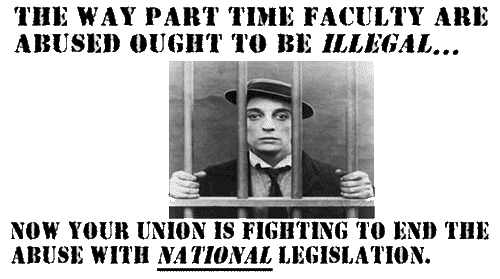
After the House of Representatives recently passed a bill shifting college financial aid away from private banks and more toward grants directly to students, the president of the American Federation of Teachers sent a letter to the House saying that the final version of the bill should inclusion language on the abuse of adjunct faculty:
The lack of attention paid to the loss of full-time tenured faculty positions, and the overwhelming growth of poorly paid part-time faculty, has been taking a toll on higher education for many years. Today, almost three out of four undergraduate instructors are contingent rather than permanent full-time faculty members-contingent faculty members teach a majority of the nation's undergraduate courses. Unless we take steps to reverse course, this trend will greatly impair the ability of our colleges and universities to reach the national goals Congress has set for them.
Specifically, we believe it is essential that programs designed to improve persistence and completion, especially those targeted at community colleges, should include provisions that encourage institutions to strengthen their instructional workforce by creating additional full-time faculty positions or providing more stability and equitable compensation for part-time faculty.I was grateful to see this campaign, but concerned about the weak language, and added the following note to the post the on the AFT website, and to my letter to our senators:
FULL TEXT
You should not just ask for language to "encourage" or "permit" this but REQUIRE it, and not just "reduce" unequal pay and compensation but END it.
Too many college administrators not only do not make ending these inequities a priority, but they actively fight against ending them.
We can not depend on them to act responsibly without forceful legislation requiring them to do so.
I also fail to see why our union can't say that schools are economically abusing people who have dedicated their lives to education, including, in many cases, not giving us health insurance, or not giving us enough to cover our families as well.
If we are going to get on the radar, we aren't going to do it by soft-pedaling the problem.
Frankly, there is potentially a very brief window for progressive action in Washington. If Democrats do not pass a strong health insurance reform bill, that window will begin to close and might well be gone after the 2010 election. If they do pass good legislation, there will be momentum that we should ride to get major things done.
We must set our sights higher than glacial, incremental change or we won't get any change at all.
LINK to write letter to senators
Article on AFT president's letter
We should use the AFT link to write to show the AFT that we appreciate the effort, but I would also ask that you compose your own letter to our senators and congressman about H.R. 3221 with stronger language than the campaign.
| | | | |
Thursday, August 27, 2009
Labor Secretary on NPR sidesteps part timer question
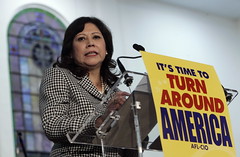 As I was leaving one of my two jobs the other day, I turned on NPR and heard Labor Secretary Hilda Solis on some NPR show taking calls. The first one I heard was from a part timer who laid out our problems pretty well: paid far less than full time colleagues, often no get no benefits, the lessened availability to students as we zip from campus to campus to patch together enough to survive, and the irony of all that given how important the president has said community colleges are. He also noted that a lot of the stimulus money went to one time building projects instead of persistent abuses like this.
Her answer was disturbing. She hemmed and hawed a lot and said this was primarily a state issue, and their job was mostly to insure that contracts were enforced. She went on to say it would be tough to fix issues like this because of the current budget crisis.
Even the host of the show said their would was little in her answer that would comfort the person asking the question.
While Solis is obviously better than the Bush secretary of labor who called teachers' unions terrorists, her answer is unacceptable for a number of reasons.
For one, the federal government intervenes in education at the state level all the time. It forced the steaming pile of excrement No Child Left Behind on K-12 schools, and more admirably, sets anti-discrimination conditions on colleges that take federal money. It doesn't take too much creativity to see how they could set minimum academic labor standards on colleges and universities.
I would have some sympathy for the budget argument if the first thing the Obama administration had done WASN'T giving nearly a trillion dollars to people on Wall Street who caused more economic harm than any terrorists could in their wildest dreams. He just recently reappointed Ben Bernanke who gave trillions more to the same crooks and refused to tell Congress how much he gave to which ones.
Wall Street hurts people on purpose to further enrich a very, very few. We do our jobs in hope that those we serve will be better citizens and better able to support their families. It is offensive for a supposedly Democratic administration to say they can do nothing for us while they give more than enough to fix our problems to sociopathic trust fund babies on Wall Street who spend the money on bonuses and parties and squirrel the rest away in offshore accounts.
audio of question & her answer
TRANSCRIPT OF PART TIMER QUESTION:CONAN: We're speaking with the secretary of labor, Hilda Solis. You're listening to TALK OF THE NATION from NPR News. And this email from Betsy(ph) in Cape Cod: I'm a part-time community college faculty member. We earn a small fraction of the salary our full-time colleagues earn for doing the same job, and many of us get no benefits. The stimulus money that was supposed to be going to keep jobs is frequently going instead to one-time capital projects. Even those of us who Re unionized - and we are the minority - are unable in the main to strike so there is very little we can do during contract negotiations. If educating people is as important as the president said, is strengthening faculty salaries, benefits and job security part of your agenda? If so, how do you propose to do it?
Sec. SOLIS: Wow. That's a big challenge. But it's one that I understand well as a former trustee of a community college and understand well the challenges, because many states by the way, who provide most of the bulk of support for funding for community colleges, their revenue has gone down. So, I know even in my own state of California many people have been pink-slipped, laid off. They've had to reduce class size and actually turn away a number of students that want to enroll in the fall, or postpone their education. So, I understand there has to be a need to help provide assistance and leadership for community colleges. And just to give you an idea, most of the training money that DOL is putting out - a lot of it will be going in partnership with community colleges. So, there will be an opportunity to hire up, to bring in more faculty and to also expand the services that community colleges offer because they are by and large the people that entertain the most number of people who go into a higher education.
CONAN: I didn't hear a lot in there that would make her happier about the conditions in which she works.
Sec. SOLIS: A lot of - I think a lot of that - certainly we want to make sure that contracts are respected, collective bargaining agreements. There's always been an issue with respect to different bargaining groups, or groups that are represented in bargaining groups, that want to be a part of that. So, I think the continuance of involvement on the part of part-time faculty members I think is a legitimate issue and should be looked at. Because as it stands, you also find that that faculty member is not as inclined to stay committed to those groups of students that they do teach because they're off to different - other -what they call, freeway traveling or teaching…
CONAN: Mm-hmm.
Sec. SOLIS: …because they're going to find wherever they can get their salary paid. And it's unfortunate that that's what it's kind of turned to. I hope that we could end that in some way. But right now with the recession being what it is, I think it's going to be difficult.
Talk of the Nation, Aug. 25, 2009
| | | | |
Saturday, July 18, 2009
Obama's Community College Initiative gives hope but needs change
Gabriel Arana at The American Prospect gets what's wrong with the community college system:
Further, while unions are the best way to raise workers' income, no one should have to negotiate their way out of discrimination and unequal compensation. That should be a matter of law. It is also difficult to negotiate when two classes of workers have been created because the employer can always say that giving to one takes away from another.
Here's my comment I posted on Arana's article:
The author's point on the corporatizing of higher ed is also dead on. Wall Street just came close to destroying the world economy--why exactly should we apply that not just failed but deadly toxic model to higher education?
Obama’s plan for community colleges is not broad enough in scope to address all these concerns, but it can still be designed so it does not perpetuate the problem. Washington, D.C.-based higher education expert Ben Miller suggests limiting what portion of the federal grants to community colleges can go to administrative costs; the fact that the money is dispersed through program-specific grants as opposed to blanket, TARP-like disbursements, he also points out, will prevent the sort of waste and lack of transparency we have seen with the economic stimulus. But this initiative is a drop in the bucket: a lot more needs to be done to stop the corporatizing trend that has steadily transformed our colleges and universities.His solution of more unionization is great, but legislation is required to end the worst abuses of adjunct faculty. Such legislation should include:
One piece of the solution lies in adjunct and faculty unionization. Non-unionized adjuncts do most of the instructional work in higher education, yet they generally have little job security, rarely receive health and retirement benefits, and are paid about a quarter as much per course as tenured faculty. Many dart from campus to campus to try to earn a living. But those at schools with an adjunct union fare much better: adjuncts at NYU, who unionized in 2004, have been able to negotiate some of the highest salaries for adjuncts and contracts that guarantee continued teaching assignments.
- every college or university have at least three-fourths of their faculty members be full time, tenure track
- that part time faculty get the same pay per class as their full time peers with the same qualifications and length of service
- that part time non-tenure track faculty be offered at least proportionate benefits compared to their full time tenure track peers
Further, while unions are the best way to raise workers' income, no one should have to negotiate their way out of discrimination and unequal compensation. That should be a matter of law. It is also difficult to negotiate when two classes of workers have been created because the employer can always say that giving to one takes away from another.
Here's my comment I posted on Arana's article:
Thanks for mentioning the abuse of adjunct faculty.
It's ironic that for all our society's bluster about valuing education, we treat those who dedicate their lives to providing it as fools and patsies.
I have to patch together two community college teaching jobs to make a living, and worked eight years before one of my schools offered me health insurance. It took about as long before I could make payments on the student loans for the degrees required to do the job. And my story is not unique.
It is time for this system of abuse to change.
The author's point on the corporatizing of higher ed is also dead on. Wall Street just came close to destroying the world economy--why exactly should we apply that not just failed but deadly toxic model to higher education?
| | | | |
Subscribe to:
Posts (Atom)