Monday, December 15, 2008

Will Obama let colleges keep treating faculty like Walmart workers?

The Huffington Post ran a good article on how colleges and universities abuse most of their faculty by having two separate and unequal classes: one paid far less per class to do the same job and usually given no job security or health benefits.

The best part of the article is the bit when she asks administrators if they aren't ashamed of doing this (which I have included at the end). I asked the same thing on the discussion board at The Chronicle of Higher Education, and administrators actually said it was our own fault because adjuncts are stupid enough to take the jobs.
KEY EXCERPTS:


Gina Nahai
Posted December 14, 2008 | 09:30 PM (EST)


The Great Shame of America's Colleges

You think Wal-Mart employees are exploited?

What if I told you that all over this country, major institutions created and sustained with a mission to pursue the betterment of mankind, colleges and universities that sit on billion dollar endowments are using the current economic crisis to further enrich themselves at the expense of the meager livelihood of long-time faculty? That at the same time as they claim to be the guardians of knowledge and the champions of the arts, they treat their faculty to the legal and financial equivalent of what migrant day laborers earn by standing outside Home Depot?

Freeway Flyers: aka "adjunct professors", aka "teaching professionals." They're the dirty little secret of universities and colleges all around the United States. They're the PhDs with decades of teaching experience, award-winning artists, published authors whose names and reputations draw students to the universities, whose work justifies the $50,000/year tuition, raises the million-dollar donations, earns the sought after rankings in USA Today's annual poll.

In exchange for all that, they are hired only on a part-time basis, made to sign a pledge that they will not work more than twenty hours a week and will not--not now, not ever--have a claim to health or retirement or any other kind of benefits, not even a parking pass. That they are "at will" employees who can be let go at any time, for any reason. Their salaries are so meager, they have to teach two, three, sometimes five classes a semester, at five different universities, just to pay their rent. That's why they're called Freeway Flyers. One writer I knew taught for twenty years at a Southern California college with more money than the GNP of a small country. He was paid so little, he had to supplement his income by working the graveyard shift at airport gift shops. He was the author of one of the biggest literary novels of the 20th century; when he died, his family couldn't afford to bury him. Another guy--a teacher of mine from the days when I was a student of writing--drove four hours each way to teach the same class for twenty-seven years. He made something near $3,000 a semester. He was recently let go because the school could take advantage of the rising unemployment rates to hire a younger person for less than $3,000.

***

Aren't the heads of these colleges ashamed of the exploitation? Wouldn't they want to do the right thing even if they don't have to?

I've asked many of them these questions, especially recently. One of them was a former peace corps volunteer. Their answers are short and scripted: "Of course we want to do the right thing; but only when possible." His colleague, another dean, lamented openly the fact that out of every professor on their payroll, there was one who could not be let go or forced to work for half her usual salary because that one, unfortunately, had a contract. Not that anyone's unhappy with the professor's work, mind you. They just don't like paying more than they have to.

FULL TEXT
Even during the darkest days of the Bush administration, higher education was an island of reasoned debate and progressive dissent. This apartheid faculty system, with a small minority given decent pay and job security, and the rest exploited and abused, is part of the right's decades long effort to crush any sources of opposition. As Karl Rove said:
As people do better, they start voting like Republicans --- unless they have too much education and vote Democratic, which proves there can be too much of a good thing.
Anything that threatens Karl Rove and his kindred spirits in the GOP should be protected and rewarded.

If you think this abuse of faculty is something that should change, tell the incoming Obama administration.

Monday, June 09, 2008

Next CA Senate leader supports equal pay for equal work--for LEGISLATORS

As part of their deal with Arnold on the budget, California legislators may be cutting their salaries, but only of those starting a new term this year, not those in the middle of a term, so three-fourths would get the cut and one-fourth wouldn't.

Wow, an arbitrary difference in pay scales not based on qualifications or work done, but strictly as a cost saving measure--who would allow something like that?

Not the California legislature, at least not when THEIR six figure incomes are at stake.

Will legislators now finally be as outraged about part time community college faculty being paid as little as 25% as much as their full time counterparts with the same qualifications to teach the exact same classes?

Part time faculty make up three-fourths of those who teach community college, but our hours are capped in any one district so we have to patch several jobs together to make a living, and unlike state legislators, it doesn't add up to six figures or often even include health insurance.

For 40 years, the California legislature has allowed this discrimination to persist, and hasn't changed the law that allows it, but only passed toothless resolutions that changed little to nothing.

Now that California legislators have had a taste of pay discrimination, will they take more forceful action to end it against community college educators?

The legislator quoted in the piece as opposing unequal pay, Sen. Darrell Steinberg, is scheduled to be a leader in the Senate.

Write him a letter, thanking him for supporting the concept of equal pay for equal work, tell him you look forward to his quick, real action on this for part time faculty who have been discriminated against for 40 years with the legislature's approval, and not just resolutions of intentions to do nothing.

Email contact page for CA state Darrell Steinberg


Since legislators filter out emails that aren't from their constituents, you may want to snail mail, fax, or call him:

Phone: (916) 651-4006
Fax: (916) 323-2263

Capitol Office
State Capitol, Room 4035
Sacramento, CA 95814
District Office
1020 N Street, #576
Sacramento, CA 95814
North Highlands District Office
5722 Watt Avenue
North Highlands, CA 95660

You should also write your own state legislators and let them know you share their pain. You can find out who represents you and how to contact them HERE.

This is also worth a letter to the paper legislators read and that ran the story, the Sacramento Bee.

Sacramento Bee Letter Submissions


KEY EXCERPTS:

This story is taken from Sacbee / News / AP State News.
Most California legislators could be hit with pay cut
By STEVE LAWRENCE - Associated Press Writer
Published 12:09 pm PDT Sunday, June 8, 2008

Some California legislators might claim to be victims of pay discrimination if the commission that sets state elected officials' salaries decides this week to impose its first pay cut.

But Jim Evans, a spokesman for Sen. Darrell Steinberg, the Sacramento Democrat who is scheduled to become the Senate's top leader later this year, said a proposal to cut some legislators' salaries but not others "would seem to violate an equal-pay-for-equal-work standard and would be seen as inherently unfair."

FULL TEXT


Thursday, January 31, 2008

Part Timer Load Boosted from 60% to 67% in Bill Passed in CA Assembly 60-0 , Now Goes to State Senate

It's not equal pay, but it will make life easier for some part timers in California.

The California Assembly voted 60-0 in favor of AB591, a bill raising the cap on part time faculty loads to 67%.

For the past forty years, part time faculty have been limited to working 60% of a full time load in any one district. This has made life especially difficult for those who taught five unit classes like foreign language instructors since it meant they could only teach one class per district and would need at least three different districts to put together the equivalent of a full load.

This bill would allow those instructors and others to teach ten units in any one district.

AB 591 originally included broader reforms including requiring equal pay and benefits for part timers, but those provisions were cut since budget cuts this year makes bills with new spending unlikely to pass.

The CFT’s lobbyist, Judith Michaels, convinced the group that originally pushed the bill, the California Part Time Faculty Association (CPFA), and the legislator who sponsored the bill, Assemblymember Mervyn Dymally, to amend the bill to include the 67% cap since the part time faculty committee had recently asked for legislation raising the cap and the broader community college council voted in favor of it.

The bill could make an equally speedy passage in the California Senate if the people affected by it would contact their state senators and tell them what to do.

How to Contact CA Senators about Raising Cap on Part Timer Loads to 67%

For every person who contacts an elected official, they assume there are ten more people who have the same opinion but are too lazy to make the effort to bug them. So if you call or email your legislators, it’s like you’re getting to vote ten times.

You can find out who your state senator is and their contact info by going to this link and entering your zip code:

FIND YOUR CA LEGISLATORS

When you call or write, just tell them you support (or oppose) AB 591, and that you are a faculty member yourself.

Monday, October 01, 2007

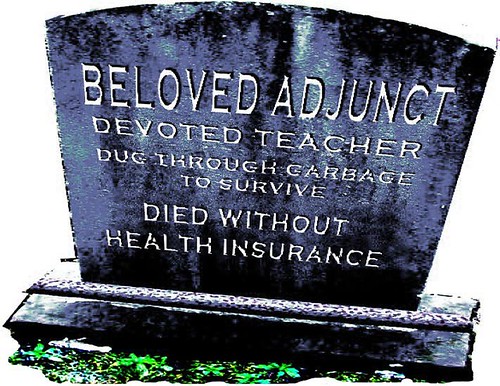
death of the trash digging professor


Sometimes I think we understate the harm done to us by the abusive and discriminatory adjunct system because we are embarrassed. Few people are comfortable telling the whole world that their checks bounced, their significant other left them because they couldn't get a "real" job, or that they still live in parents' basement at 50. If you can't bring yourself to tell your story, tell this guy's, originally told by Barbara McKenna in AFT on Campus:

Adjunct teacher Marty Slobin’s obituary in the Dec. 12, 2000 edition of the Detroit Free Press is moving for its brevity. It memorializes the lecturer who had received a distinguished teaching award from the University of Michigan-Dearborn just the year before and who also taught at Wayne State University and Henry Ford Community College.

“Words cannot describe what this man does in the classroom,” a former student says.

Outside the classroom, Slobin commuted to his teaching jobs on three campuses by bus because he could not afford to keep a car.

“Marty’s whole life was devoted to his students and his teaching,” says a fellow professor.

Suffering from heart disease, Slobin could not afford the treatment—surgery—because the income he lost during a convalescence would make it impossible for him to keep up his health insurance premium payments.

Slobin had “succeeded in making the study of political science meaningful in the lives of his students,” the paper quotes Bernard Klein, a former interim chancellor of the university.

At one point, the university asked Slobin to stop going through the trash in search of the pop cans he returned to collect their deposit refunds.

“I attended his class on congressional elections earlier this fall,” says the university chancellor, Daniel Little, “and was able to see firsthand the respect and affection his students felt for him.”

Slobin, 55, died on Dec. 6 in his office after a heart attack. He was so poor, says Bonnie Halloran, president of the Lecturers Employee Organization (LEO)/AFT at the University of Michigan, that faculty at Dearborn and the neighboring community college took up a collection to pay for his funeral.

FULL TEXT

If your story isn't as extreme as his, it's probably because you have a job in another industry, a spouse, or some other relative who takes up the slack. Without one of those safety nets, most of us could be this guy.

Sunday, September 30, 2007

LETTER TO LEGISLATORS:
Grandparents paid for me to go to college,
now they pay for me to TEACH college

A letter I sent to my assemblymember, and members of the Assembly Higher Education Committee:
Assemblymember,

My grandparents gave me money to go to college.

Now they have to give me money to TEACH college.


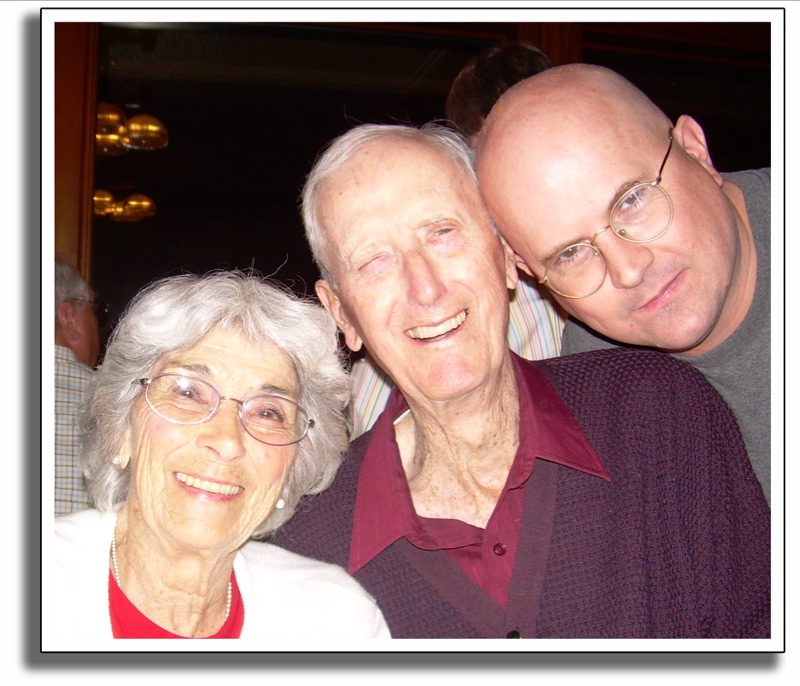
I thought if I got a master’s degree and taught college, I’d be able to support myself. But because I can only get part time faculty jobs that pay as little as a third as much as a full time teaching job per class, offer no health insurance most of the time, and have gaps in pay between semesters and no guarantee of work or enough classes to survive from semester to semester, I have to ask my 86 year old grandfather and his 89 year old wife to help me out.

My grandfather is proud to help me because I'm the most educated person in my family, and being a "professor" looks like part of that American Dream about each generation doing better than the one before.

Ironically, with two years of college, he was able to own a house and support a stay at home mom and three kids by my age while I consider myself lucky to make my rent, and that I have one school that provides health insurance for me alone (no family allowed).

I taught for eight years at four different districts before any of them offered me health insurance. Before that, I was paying $200 a month out of pocket for a long-term medication.

I took out $50,000 in student loans to get the degree that’s required to do my job. That’s ballooned to over $100,000 with interest because it’s been tough to pay with irregular work and having to pay for any medical expenses out of pocket for eight years. My student loan payments are more than my rent.

I also work more than a full time load when my multiple jobs are added together, and split the difference between what I can teach effectively and the number of classes I need to pay my bills.

I wish my story were unique, but I know many part time faculty members who only have health insurance through their spouses or have none when a major medical crisis like cancer comes up. Others still live with their parents in their forties and fifties because they love teaching in spite of how we are treated.

Community college districts do this with the legal fiction, allowed by state law, that we are "temporary" employees even though most of us will work in the same districts for decades. They only offer us part time jobs to avoid providing health insurance or fair pay even though when you add the multiple schools most of us are employed by, we work more than full time for these state-financed schools.

What kind of morals and what about the value of education are we teaching our students when college instructors are treated like suckers and Walmart employees?

Something is profoundly wrong when our education system is aping the worst practices of the private sector rather than leading by example. Administrators have failed to act responsibly in these matters and need more guidance from the legislature.

If the Assembly approves AB 1343 or AB 591, it would go a long way toward ending these abuses.

Sincerely,


To support these bills, you can comment directly on them at these links:

AB 1343 comment form

AB 591 comment form

Cross-posted at FACE Talk


Get candidates (even presidential ones) on record about FACE during primary season

Most of the time when you talk to politicians about correcting a basic injustice they will complain about how much money it costs, how the opposition party or other interests will resist it, or how it will never be signed by your governor.

There is one time when politicians, particularly Democrats, are EAGER, to promise action to educators: when they are running against an opponent in the primaries. They can't afford to have a key constituency like us apathetic and despondent on election day.

In California's last governor's race, I got the democratic candidates for governor on the record supporting equal pay and ending discrimination against part time faculty

(unfortunately, the winner was running against Arnold Schwarzenegger, and unlike Arnold, he hadn't made dozens of action movies that could be played on continuous loop on cable before the election).

All it took to get that promise was showing up at a candidates forum on a Saturday afternoon, and writing a question on a little card. I wrote a follow up letter to the winner to get him to confirm his promise in writing, which he did.

If your state has a governor's race or a contested primary for your state legislator, go ask them. If the seat isn't contested or the likely winner isn't likely to support equal rights for part time faculty, ask them anyway. You can use it to remind other faculty members why they SHOULDN'T vote for that person.

Since this is a presidential election year, you have an opportunity to take this a level higher.


When you find out a presidential primary candidate will be in your area glad-handing, show up and ask them if they would sign a bill ending discrimination in pay and benefits against part time and contingent faculty.

The Democratic candidates are desperate to get labor support and will be unlikely to say no. John Edwards in particular has made being labor-friendly a centerpiece of his campaign.

If you can get it on tape or video, even with your phone camera, so you can post it online, even better.

Does this mean the candidate will push legislation or even sign a bill if elected president?

Who knows.

But if you get them on the record saying they will, you can use that to draw attention to the abuse of adjunct faculty and to show state legislators that they are behind the curve and better act fast if they don't want to end up looking like the Orville Faubus of the 21st Century.

Cross-posted at FACE Talk


Sunday, June 03, 2007

BARBARA EHRENREICH on Part Time Faculty in "CEOs vs. Slaves"

We are mentioned in paragraph seven:

But a parallel kind of splitting is going in many of the professions. Top-ranked college professors, for example, enjoy salaries of several hundred thousand a year, often augmented by consulting fees and earnings from their patents or biotech companies. At the other end of the professoriate, you have adjunct teachers toiling away for about $5000 a semester or less, with no benefits or chance of tenure. There was a story a few years ago about an adjunct who commuted to his classes from a homeless shelter in Manhattan, and adjuncts who moonlight as waitresses or cleaning ladies are legion.

FULL TEXT


The next paragraph talks about people who should be our natural allies, lawyers and other advanced degree "perma-temps," who mistakenly thought that if they got a masters or higher, they would at least have secured a place in the middle class.

This is why attacking the definition of temporary may be an issue that resonates with people outside academia.

The temping industry and model of employment has grown far beyond fluctuations in companies' demand for labor as might happen with tax accountants for example. Instead, like our situation, many businesses have a constant rotating cadre of temps to avoid benefits or employees who accumulate seniority or much scrutiny about why someone is let go.

Since a lot of people will be reading this story, you might want to post a testimonial comment about how you have been screwed as an adjunct in the comment section at the end, to raise public awareness.

POST COMMENTS AT BOTTOM

And contact Ehrenreich with your stories and what we are trying to change, so she might revisit this issue in another column in the future.

EHRENREICH CONTACT PAGE

She also has a blog & organization for screwed professionals.

This is the first I've seen of her blog, but it's worth a look.

Saturday, May 05, 2007

AFT fights abuse of Part Timers with national FACE campaign

The American Federation of Teachers has introduced legislation in eleven states to end the separate and unequal treatment of part time faculty.

While there are differences in the wording of the bills in various states, but a couple of principles run through all of them:

  • equal pay for equal work
  • health and other benefits for part time faculty
  • reversing the trend of relying on part time faculty instead of a full time tenured instructored corps.

The strongest language for equal pay is in the Washington state bill:

____________________________________
WA Senate Bill 5020

Section 3
Paragraph2

...part-time faculty must be paid on a pro rata basis, based upon the percentage of full-time faculty teaching load. For example, part-time faculty who work fifty percent of a full-time teaching load must be paid fifty percent of a full time salary.

WA LEGISLATURE PAGE ON BILL
____________________________________


Other paragraphs work out the consequences of that like how you move up the scale, so if you work a 50% load, you move up 50% of a full time step. That sounds fair.

Here in California, the AFT has a bill in the pipe, AB 1343, and CPFA, the California Part Time Faculty Association, has introduced a similar bill, AB 591.

You can track both by going to the California legislation search page and entering the bill number (for some reason, they don't keep set addresses for the bills).

You can see all the FACE bills and info on the FACE campaign at FACE.AFT.org.

If you live in one of the states where they have these bills, write your state legislators telling them to support it, and find out from the AFT who is running your states campaign and ask what you can do to help. If you aren't in one of those states, call up your union leadership and ask why they haven't introduced a similar bill.


Friday, May 19, 2006

class action lawsuit got health insurance for PTers in WA state--did it help equal pay bill?

The judge in the health insurance case slammed the legal fiction that we are "temporary" employees even after working in a district for decades:

law firm of Bendich, Stobaugh and Strong, P.C.

The settlement ends a five-year class action lawsuit filed by Eva Mader of Bellevue and Teresa Knudsen of Spokane. They worked more than half-time for 21 and 10 years, respectively. In June 2003, the Washington Supreme Court ruled in favor of the instructors and reversed decisions by the Health Care Authority, the Superior Court, and the Court of Appeals that denied the part-time instructors health care benefits in the summer, even though full-time instructors, who also do not work in the summer, have benefits all year.

The Health Care Authority had said that Mader, who worked for 21 years, was not eligible because she was a “temporary” quarter-to-quarter employee. The Supreme Court ruled that the Authority “must examine the actual work circumstances of a state employee, rather than the contracts or titles under which he or she is employed, to determine whether an employee is eligible for state-paid health benefits.” The Court said, “Twenty-one years is not a temporary position.”

http://www.bs-s.com/ptfhc.htm


This is the kind of thing that should put the fear of God in legislators. They need to know that if they don't end this separate and unequal system, we will seek other remedies. Frankly, I don't see much downside to this, in light of the victories WA got on retirement benefits too, and it probably gives their legislature an incentive to treat the pending equal pay bill seriously since they know a judge may correct their morally and constitutionally defective work if they don't.

Retirement lawsuit in WA state:
http://seattlepi.nwsource.com/local/coll04.shtml

Campus Equity Week update from WA state:
http://www.campusequityweek.org/CampusEquityWeek/articles/update-wa.htm

Politicians seem to respond to only one of three things:

  1. donations

  2. a large number of angry people

  3. court orders

The first two have gotten mixed results at best here in California. Maybe the relevant committees in the legislature need to know we are considering this, so they could pre-empt it with legislation, and look like the good guys.


Thursday, May 18, 2006

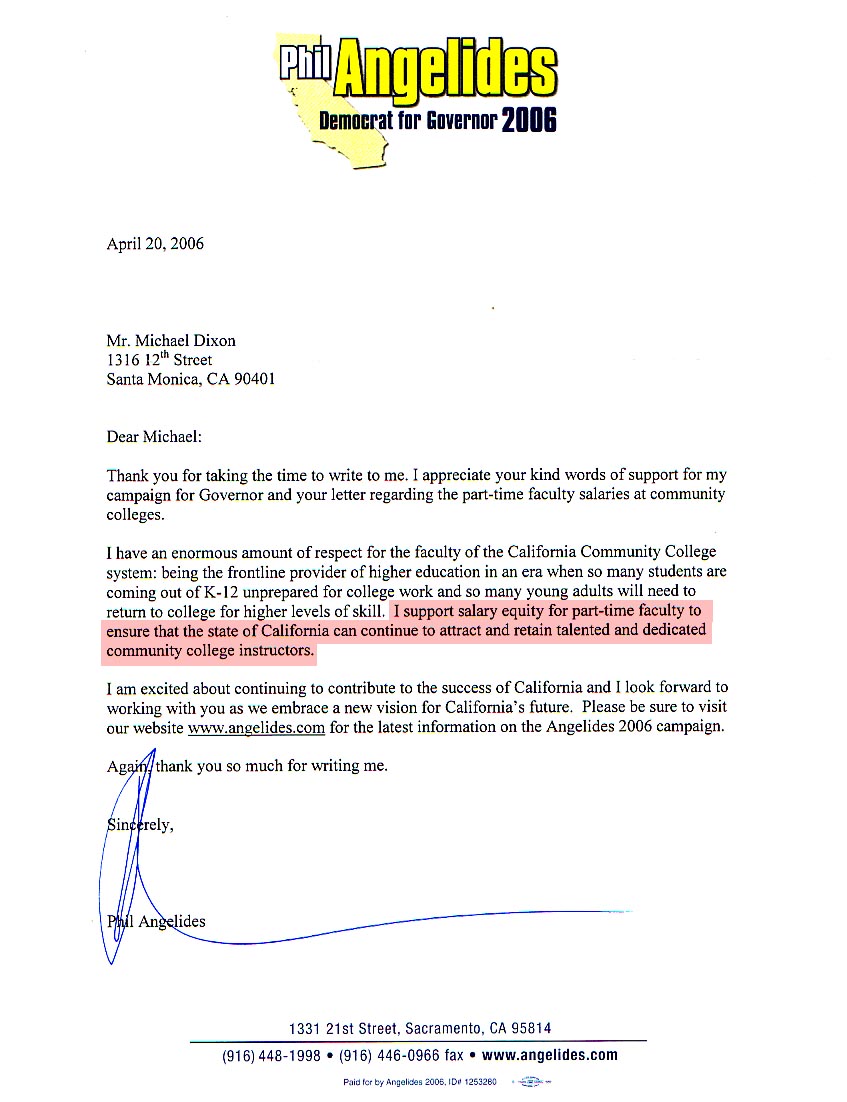
Angelides letter supports
equal pay for part timers

The key sentence says:

I support salary equity for part time faculty to ensure that the state of California can continue to attract and retain talented and dedicated community college instructors.

Phil Angelides 4/20/06


Click letter to see full-sized.


Board votes against even PRINCIPLE
of equal pay for part timers

The mechanism for achieving parity set up in AB 420 seems to assume that trustees and administrators have the welfare of the faculty at heart, and merely differ with us about how to look after it.

They do not.

Those of us who have worked for districts where they don't even make the pretense of providing part timers with health care know this. They literally do not care if we drop dead.

And now, the board of trustees of one district has voted against even the PRINCIPLE of equal pay for part timers.

This evidence should be presented to legislators to show that if equal pay is not REQUIRED BY LAW, districts will drag their feet, and even when it is achieved in some places, try to roll it back when they get in a budget jam or just want to pad their reserves even further.

A law like this already exists for K-12, and has been proposed in Washington state. We need an equal pay law here too.

These guys don't seem to have a webpage yet, so I'm passing it along for them.

The gist is in the first paragraph.

From Adjunct Faculty United of North Orange:
(DRAFT) FOR IMMEDIATE RELEASE


On Tuesday, May 9, the North Orange County Community College District Board of Trustees voted “no” on the principle of parity for part-time faculty. Adjunct Faculty United, the union that represents all part-time faculty in the district, had asked the board to take a public stand in favor of the principle of “equal pay for equal work” for all faculty.

In the North Orange County Community College District, comprised of Fullerton College, Cypress College, and the School of Continuing Education, part-time faculty (who make up two-thirds of all faculty), get about 50% of what full-time faculty make when they teach the same classes. This is different from what part-time teachers make in the K-12 system, where a teacher with the same credentials and same experience is paid at the same rate as an equally qualified full-time teacher.

Four trustees, Leonard Lahtinen, Michael Matsuda, and the two student trustees (whose votes are only advisory), voted Tuesday in favor of pay parity. Five trustees, Donna Miller, Jeff Brown, Molly McClanahan, Manny Ontiveros, and Barbara Dunsheath, voted against the resolution. Four of the five trustees who opposed the equal pay principle are up for re-election later this year.

NOCCCD Chancellor Jerry Hunter encouraged the trustees to vote “no”, saying that a positive vote would set a bad precedent, that the board should put this issue into the hands of the district negotiating team.

Denny Konshak, chief negotiator for the part-time faculty, objects, saying that it is both proper and right for the trustees to take a public stand in favor of the principle of pay parity, and then leave the details to be worked out at the negotiating table. President of Adjunct Faculty United, Sam Russo, agrees: “In the five years we’ve had our union, the district’s negotiators have staunchly refused to subscribe to any reasonable definition of pay parity for its part-time instructors. It’s time these trustees, who are publicly elected and accountable, take a firm stand on this basic principle in the American workplace and send a real message to their employees and their negotiating team.”

Several trustees stated that they were concerned that their “no” vote might send the wrong message to their part-time faculty, but still opposed the motion that would have made equal pay a goal in NOCCCD. At least one trustee seemed surprised that his district paid $30 an hour less than a neighboring community college district. Reasons for opposing the goal of pay parity with full-timers included: we don’t know what “equal” means, and the college district might be sued some time in the future if they don’t live up to this principle.

Founding president of Adjunct Faculty United, Linda Cushing, also spoke at the board meeting in favor of the principle of “equal pay for equal work” She addresses the trustees’ fear that they will be sued if they do not reach that goal. Cushing said, “At the beginning of the board meeting, everybody, including the trustees, recited the Pledge of Allegiance, saying they subscribed to the principle of ‘liberty and justice for all’. Tell me the board is equally worried about a mythical lawsuit by someone charging them with violating liberty and justice.”

A number of other community college districts, such as San Francisco City College, Cabrillo College, and San Jose-Evergreen CCD, have put themselves on record supporting the principle of equal pay for part-time faculty when the funds become available.

_________________________

For more information, contact:

Sam Russo
Office: 714-526-5759
Home: 714 –961-8058
Cell: 714-290-1685
Srusso@elcamino.cc.ca

Denny Konshak
Home: 714-962-4766

My addition:

To share your thoughts with the NOCCCD trustees:

http://nocccd.cc.ca.us/Trustees/TrusteeBios.htm


Sunday, April 23, 2006

Both Dems for governor will sign
EQUAL PAY FOR PART TIMERS bill

At a candidates forum in Culver City yesterday, both Phil Angelides and Steve Westley said they would sign a bill for equal pay for part timers in response to my question. When Pacifica posts the audio file, I will post it here.

Westley said he has taught college before and accurately described our life as "freeway flyers." Without hesitation, Angelides said he would support it itoo.

If someone has a chance to see them in other forums and ask the same question, they should, and make it clear it's something we'll hold them to.

Then we should work to put a bill in front of whichever ends up in office.


Friday, April 14, 2006

AFT resolution on equal pay for part timers

Resolution on Part-time Faculty Compensation and Benefits (2000)

[excerpt]

RESOLVED, that the AFT mobilize at all levels through organizing, bargaining and public policy advocacy to end the financial and professional exploitation of part-time faculty...

RESOLVED, that the AFT promote the principle of equal pay and benefits for equal work for part-time faculty with equivalent qualifications and experience...

FULL TEXT


CA Academic Senate on equal pay for part timers

The Academic Senate for California Community Colleges did a report, "Part-Time Faculty: A Principled Perspective," that listed several studies and government agencies that said part timers should get equal pay for equal work. The problem was they no one wanted to vote to force districts to do this.

How can so many people say that it is wrong to do something, but essentially do nothing to stop it?

They also seem to ignore the fact that in addition to saving money, underpaying part timers gives districts an edge in collective bargaining--they can make it seem like any part timer gain takes away from full timers, and vice versa, one of the oldest union-busting tricks in the book: divide and conquer. That hardly fits their goals of having one unified faculty.

The only argument in favor of keeping unequal pay for part timers is that it will cost money to fix it. But have you ever noticed how creative districts are about finding money for buildings and executive salaries and perks? That creativity will kick in on equal pay if it becomes the law.

Excerpts on equal pay from "Part-Time Faculty: A Principled Perspective":
The Council of Faculty Organizations (COFO) Faculty Equity Statement.

[adopted by the Academic Senate in 1996]

Part-time faculty should be accorded fair compensation, professional respect and due process. It is the recognized role and responsibility of individual bargaining agents to make the contractual gains that will benefit part-time faculty which in turn will improve the educational quality of the institutions that employ them. However, we, the representatives to COFO, urge support for the following rights for part-time faculty: pro-rata pay, contractual considerations for full-time positions, health benefits, seniority on re-hire rights, paid office hours, legitimate STRS pension opportunities and true professional status relating to teaching and learning issues.

Comparable Pay for Comparable Work

Responding to early concerns about the System's overuse and abuse of temporary assignments, the Board of Governors adopted a policy of "equal pay for equal work" in 1977.

Board of Governor's Policy on Pro Rata Pay, Adopted March, 1977


The Board of Governors finds no basis for differing pay schedules for full-time and part-time Community College faculty members where in class and out of class responsibilities are the same. Therefore, in such instances the Board of Governors supports equal pay for equal work (pro rata pay). In instances where part-time faculty have less than the same responsibilities for out of class activities the Board of Governors favors pro rata pay for them equal to that which would be paid to full-time instructors for similar classroom activities.


Assembly Bill 420 (Wildman)

AB 420, in its initial form, would have required that "each person employed by a community college district as a temporary academic employee shall be compensated at a salary or hourly rate that is directly proportional to the salary of a full-time regular employee with comparable training and experience." It would also have established in law a minimum of part-time faculty benefits pro-rated with regard to full-time faculty benefits as well as a seniority-based system of preference for reappointment of part-time faculty continuously employed for three academic years.

Though the bill rapidly passed through Assembly committees and on to the Senate Education Committee, concerns were raised by the Chancellor's Office and local college and district administrators regarding the seniority-based rehire provisions. [final form was largely gutted with only token nods toward equal pay]

The California Postsecondary Education Commission (CPEC) Report


  • The Commission recommends that local community college districts be encouraged to develop salary schedules for part-time faculty members which have structures more comparable to that of full-time faculty.

  • The Commission recommends local community college districts examine the current distribution of compensation resources among part-time and full-time faculty within their district, particularly in those districts where the difference between full-time and part-time faculty salaries is greatest.


Using this classification of what constitutes teaching activities, CPEC calculated that, on average 81% of a full-time faculty member's activities were teaching-related (19% were the sum of advising, administrative, and other activities). Recognizing that the distinction between "advising" and "office hours" is based largely on contractual language rather than the teaching-related nature of the work, and that elements of the "administrative" and "other" classifications would more appropriately be classified as teaching-related, we can see the CPEC study as a confirmation of the State Auditor's determination that part-time faculty are currently expected to fulfill 88% of the duties of a full-time faculty member. Further, since CPEC, like the State Auditor's assumptions, ignored the fact that faculty report working significantly more than the standard 40-hour week, the CPEC analysis supports the view that the current teaching activities of full-time faculty are about 90-91% of their total professional activities.


Recommendations to Local Academic Senates

1. The Academic Senate recommends that local senates work with their local collective bargaining agent, administration and board of trustees to establish principled definitions and policies regarding part-time faculty pay equity, "comparable pay for comparable work" and what should be the professional expectations of all faculty.

FULL REPORT


CA State Auditor's report on part time pay

When the California State Auditor investigated part time compensation in 2000, they found that if a part timer worked the same hours as a full timer, they would still make 31% less.

The auditor also point out the hypocrisy at all levels on this--while legislators, the state chancellor, and even some administrators (that last one is unlikely) support the concept of equal pay for equal work, it is not given the force of law so that districts have "flexibility" at the bargaining table. In essence, the auditor acknowledges that school districts are cutting ethical corners to balance their budgets.


California State Auditor/Bureau of State Audits
Summary of Report 2000-107 - June 2000

California Community Colleges:
Part-Time Faculty Are Compensated Less Than Full-Time Faculty for Teaching Activities


(excerpt)

...For the fall 1999 semester, the districts reported to the Chancellor's Office a total population of 41,754 teaching faculty, of which 28,180 (67 percent) were classified as part-time and 13,574 (33 percent) as full-time...

Overall, part-time faculty earn lower wages and receive fewer benefits for teaching activities than full-time faculty with similar education and experience. Specifically, at the eight districts we reviewed, if part-time faculty were to teach a full course load at their current pay, they would receive an average of $13,042 (or 31 percent) less in annual wages than full-time faculty for teaching activities. In addition, none of the eight districts enhance the pay rate of part-time faculty who have more education and experience as attractively as they do for their full-time instructors. Also, by working in more than one district, some part-time faculty teach as many classes as full-time faculty but receive less for their efforts. Furthermore, the eight districts either do not provide medical benefits to part-time faculty or provide such benefits with restrictions that are not imposed on full-time faculty. Finally, it is more difficult for part-time faculty to obtain the retirement benefits provided to full-time faculty.

Depending on one's policy perspective, the unequal compensation of part-time faculty either creates problems that should be addressed or reflects an appropriate balance of market conditions at the local level that should not be tampered with. In particular, all of the eight districts we reviewed indicated that the existing pay disparity between part-time and full-time faculty creates a financial incentive to use part-time faculty over full-time faculty his incentive is not in keeping with current Chancellor's Office standards, which stress the importance of maintaining a balance between part-time and full-time faculty to ensure the quality of a CCC education. Furthermore, legislative intent, Chancellor's Office policy, and some district administrators' views support equal pay for equal work for part-time faculty. The general argument is that since the colleges hold part-time faculty to the same standards as full-time faculty, they should offer them the same pay. On the other hand, the former governor, the Chancellor's Office, and certain district administrators oppose mandating equal pay for equal work because it would interfere with the collective bargaining process and limit local flexibility....

SUMMARY

FULL REPORT (PDF)


K-12 equal pay for part timers CA law

California Education Code:

45025. Any person employed by a district in a position requiring certification qualifications who serves less than the minimum schoolday as defined in Sections 46112 to 46116, inclusive, or 46141 may specifically contract to serve as a part-time employee. In fixing the compensation of part-time employees, governing boards shall provide an amount which bears the same ratio to the amount provided full-time employees as the time actually served by such part-time employees bears to the time actually served by full-time employees of the same grade or assignment. This section shall not apply to any person classified as a temporary employee under Sections 44919 and 44888, or any person employed as a part-time employee above and beyond his employment as a full-time employee in the same school district.

http://caselaw.lp.findlaw.com/cacodes/edc/45022-45061.5.html

The loophole in this law is the same one used on part timers at the community college--the legal fiction that we are temporary employees.

If we work at the same school continuously for five, ten, or twenty years, we are hardly temporary.

Thursday, April 13, 2006

Ask governor primary candidates for equal pay law

The California primary is June 6, and the two candidates are neck and neck in the polls. Tell them to pledge to sign an equal pay for equal work bill once in office, so part timers have a reason to vote in the primary instead of waiting for the general election.


Letter to Phil Angelides:

(click to see full sized)


Letter to Steve Westley:

(click to see full sized)


Tuesday, April 11, 2006

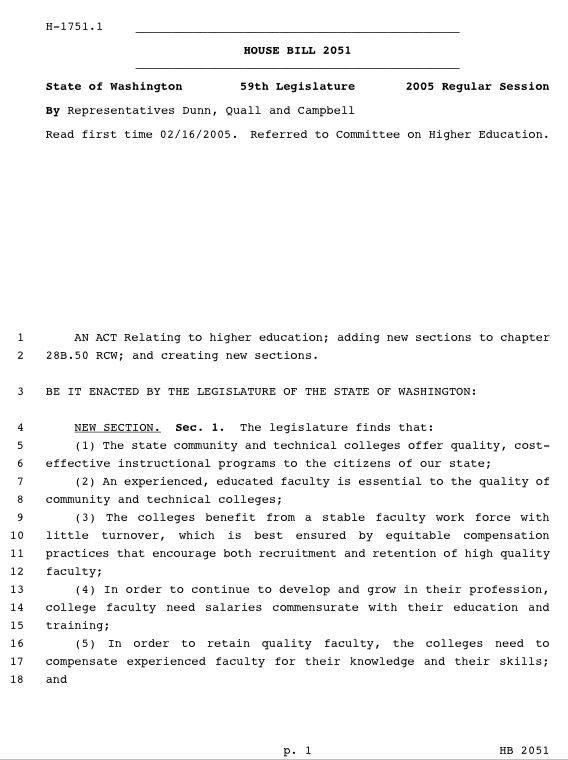
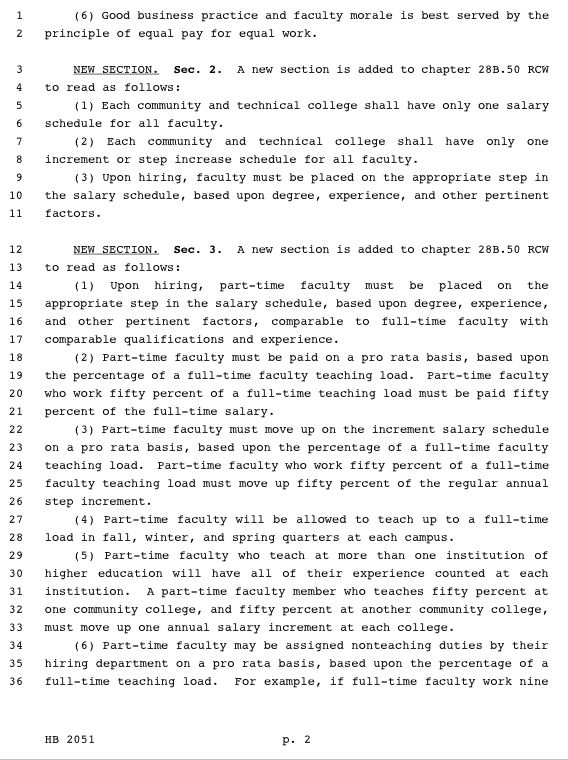
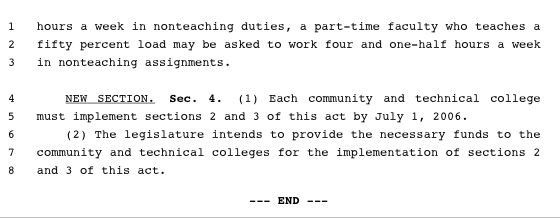
EQUAL PAY for Part Timers Bill in WA state

Washington state has a bill in both houses that demands part time faculty get pro rata pay, one pay scale for part timers and full timers.

As long as we treat this as an issue for district by district negotiation, administrators can use the part time/ full time issue to divide us over an issue that should be a basic civil right.

The text of the house version is below.


Link to track House version:

http://apps.leg.wa.gov/billinfo/summary.aspx?bill=2051&year=2005

Link to track Senate version:

http://apps.leg.wa.gov/billinfo/summary.aspx?bill=5871&year=2006


(click to see full sized)


Monday, April 10, 2006

FAXED APPEAL TO STATE SENATOR ABOUT EQUAL PAY FOR PART TIMERS:

April 2, 2006

Sen. Sheila Kuehl
State Capitol, Room 5108
Sacramento CA 95814

Sen. Kuehl,

I have a profound respect for your work on SB 840, and need your help on another issue of basic decency and social justice: equal pay for equal work for part time faculty at community colleges.

We are required to have the same qualifications as our full time colleagues and teach the same classes, but are paid as little as a third as much per class, and at most schools aren’t even offered health insurance. As a result, most of us patch together jobs in two or more districts since we can only work 60% of full time in any one place. Ironically, we end up teaching more hours than our full time co-workers just to survive.

It is difficult to explain the value of a higher education to our students when our jobs that require masters degrees don’t pay enough to make our student loan payments, to go to the doctor, or sometimes even to make rent.

Section 45025 of the California Education Code already requires K-12 schools to give pro rata pay to part time instructors, and the state of Washington has bills in both their house and senate requiring schools to give equal pay to part timers.

Past legislative remedies have been so tepid and full of loopholes that the money set aside to equalize part timers pay largely ended up in the pockets of administrators.

California should not have to wait for other states to set the example in ending this abuse of college instructors, particularly since the Assembly and Senate have democratic majorities who depend on teachers to vote to keep them in office.

If you sponsored a bill, mandating equal pay for equal work for part time community college faculty, it would go a long way toward correcting this problem. If you cannot do so, please let me know who would be the best legislator to address about this.

Sincerely,
Michael Dixon


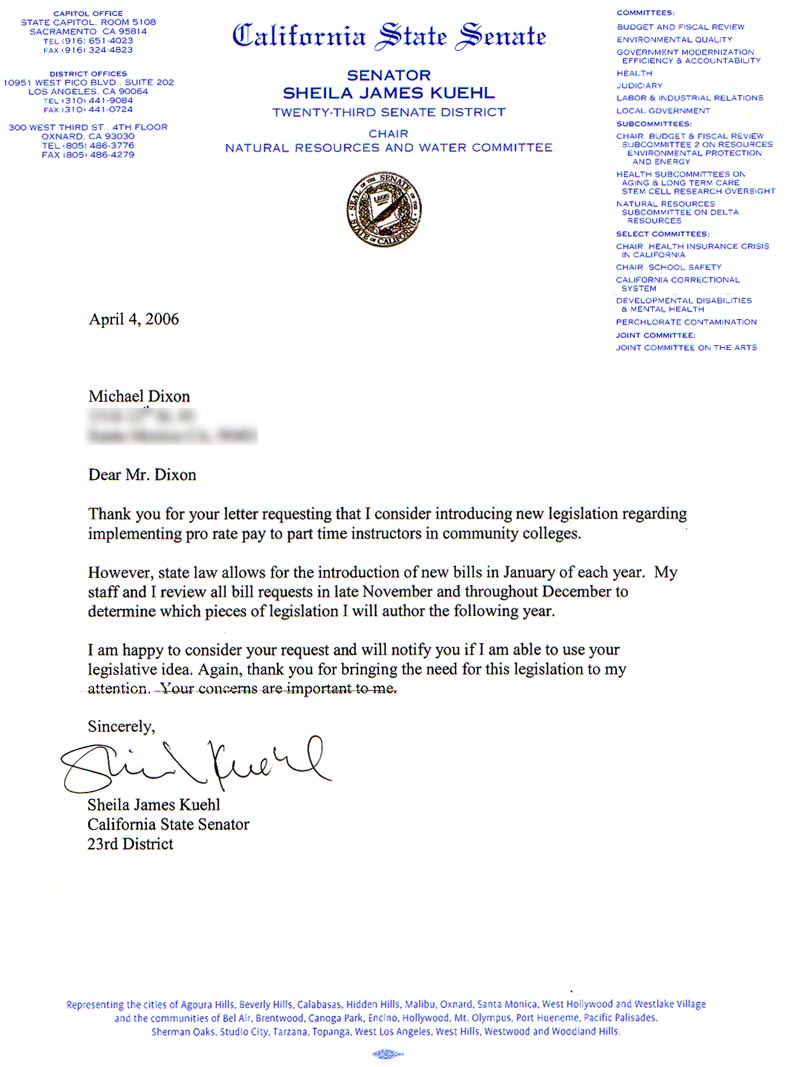
HER RESPONSE:

(click to see full-sized)